Friday, November 19, 2021

Thirty Day Map Challenge - Part 2

Here are the next batch of maps I've posted for the #30DayMapChallenge. The first ten maps are here.

Day 11 - Theme: 3D

For the 3D theme I attempted to recreate an exercise from my first cartography class back in the 1980's. That exercise was done using a pencil and graph paper. Unfortunately, I do not have my notes or remember the exact procedure. I did this one using GIS software instead. The map shows murder rates by state. Back then North Carolina was #1, now it's Louisiana. The map is "upside down" so that the higher southern states don't block the view of the lower northern states.

Day 12 - Theme: Population

This is a map of Arctic settlements done "firefly" style, which is fashionable these days in cartography circles.

Day 13 - Theme: Data Challenge 2: Natural Earth

Natural Earth is a set of publicly available data. It is a collaboration involving many volunteer NACIS members and cartographers around the globe. Nathaniel Vaughn Kelso and Tom Patterson led the effort. They have produced some beautiful topographic images of the world. The map was also inspired by a NACIS talk on indigenous place names. The topography and streams are from Natural Earth, while the place names came from Canada's Open Data site.

Day 14 - Theme: Map with a new tool

This one is a bit of a mess because I started doing a tutorial using R, a new tool for me, but I ran into some technical difficulties and then ran out of time. I never expected that Sunday, a non-work day might be the day that I run out of time. I had seem some recent Excel maps and made a blog post about this one. At the last minute decided to try one. Last Spring I tried my hand at a cross stitch map of Rochester, New York. This seemed like a natural fit for an Excel map since it is very grid-like. Instead of doing land use though, I tried doing one of those HOLC redlining maps from the 1920's. 

Lack of time forced me to go very low res. so the map ends up looking like not much at all.

Day 15 - Theme: Map made without using a computer. 

Several of the previous maps were hand drawn but I decided on a different approach here. This is a souvenir Pennsylvania cutting board stacked with coins representing the GDP of the metropolitan areas of the state. One cent = $1 Million. It's a nice, even formula but does not make the stacks high enough to really show the pattern well. Since it is helpful to see multiple angles, I created this mediocre video.

Day 16 - Theme: Urban/rural

This was mostly just an exercise in image manipulation to tease out the urban and rural areas by land cover. I picked Charlotte after looking for cities that might have an interesting looking pattern.

Day 17 - Theme: Land

While waiting in the San Diego Airport a few years ago, I noticed a display of Kumeyaay culture. I was unaware of these people as I suspect many are. There were a couple of maps which I later found copies of on a website dedicated to Kumeyaay culture. I find it interesting that their territory predates the US-Mexico border which has been imposed on their land. This is what the area looked like pre-border.

Day 18 - Theme: Water

This was just a fun exercise in grabbing some water data from northern Quebec and overlaying it on top of a cheesy tree pattern that I made just for this purpose. More art than map. The large lake in the west is Lac Couture, an impact crater.

Day 19 - Theme: Islands

I've always been fond of Christo and Jeanne-Claude's Surrounded Islands installation so I decided to map it. Buffering is one of the most common and basic GIS functions (ie. is this property within 200 feet of the river?), here was an example of a real world buffer.


More to come (I hope).

Wednesday, November 10, 2021

Thirty Day Map Challenge - Part 1

 Several years ago Finnish cartographer Topi Tjukanov began the Thirty Day Map Challenge and it has run every November since. The idea is to create a map every day of November based on a theme he posts at the start. These maps are posted to Twitter using the hashtag #30DayMapChallenge. There have been some wonderfully inspiring maps created in this process. I had never participated before this year, correctly assuming it would take up a major part of my time and energy. 

As in other years, I had no plans to do this but on November 1st I suddenly found myself making a map and it took off from there. At the risk of being a self-indulgent show off here are the first 10 maps. As of right now I don't have an online portfolio so here is a place for me to post them. I'm hoping to continue on this challenge but time will tell if I make it to the 30-day mark.

Day 1 - Theme: Points

I'd been working on a general "where I've been" map and I got to thinking about places I've spent the night. I looked at a few states that either didn't seem interesting or had too many uncertainties when I settled on Ohio. I've been working on my weak artistic skills. This was drawn in watercolor pencils by hand while looking at a map of the state.

Day 2 - Theme: Lines


 I don't really like the song "Every Day is a Winding Road" by Sheryl Crow, but somehow it got stuck in my mind and I set out prove it. I used various mapping services such as Google, Bing, Apple and OpenStreetMap to illustrate examples of streets around the world named for the days of the week. One of the tricky parts was finding streets that are in fact "winding."

Day 3 - Theme: Polygons

Points, lines and polygons are the main building blocks of maps so each one gets a day. DC seemed like a good polygon city. I used Opendata DC to get my points. I removed some tiny triangles and it's possible I missed a few circles and squares. There are many rectangular parks that I didn't include because they don't have "square" in their name. I almost forgot about the Ellipse! 

This was a mixed media project. I made and printed a map using QGIS annotated it with pencils and put a little watercolor into the rivers.

Day 4 - Theme: Hexagons


Hexagons are a popular way to represent grids these days. Studies show that certain patterns are easier to detect with a hexagon grid than a square grid. They are particularly popular with election maps but I was looking to do something a little more creative. Not many things in nature are hexagonal. Bee hives use that shape but that kind of map has been done by many others.  While looking for inspiration, I discovered that some of Annie's Snack Crackers are hex shaped, including their saltines and cheddar crackers. I decided to use them as my hexagons.

    So where is a place that has both salt and cheese production? I settled on upstate New York, knowing where some of these places are located. The salt areas are mostly based on an old map I found showing salt deposits, mostly in the southwest. I also know of a couple of salt facilities from my travels so I put those in. I used the term "more likely" to cover the uncertainties but some of those hexagons in the southwest should probably be cheese. The cheese areas were determined by a combination of dairy farm maps and places I know that make cheese.

Day 5 - Theme: Data Challenge 1: OpenStreetMap


For the uninitiated, OpenStreetMap (OSM) is like Wikipedia meets Google Maps. Content is all user generated and it is freely available to use. Despite having contributed to OSM in the past, I don't have a lot of experience using the data so this was definitely a learning exercise. I knew that you can get things like businesses out of it so I tried a query on business names. For some reason, the first word that came to me was "monkey" so I grabbed all businesses with monkey in the name. After seeing an empty South America, I decided to add Spanish and then to make it a bit more objective I grabbed the other three of the world's top languages. In the process this became as much of a linguistic map as anything. 

There are many translation issues here. French and Spanish have different masculine and feminine words and the Spanish words (mona, mono) are contained within many other words and names. My Hindi translation must have been especially off since all my results came from outside of India. Anyway I did what I could here.

Day 6 - Theme: Red

Getting personal here. This is a map of the town where I was born. I was nervously waiting my turn to perform some music on Zoom and parlayed that energy into drawing. Like #1 I tried this completely freehand, while looking at Apple Maps. I've only been through Red Bank as an adult on a train so I don't know the place at all. Someday I hope to visit. The river west of downtown is very wrong and there are other mistakes. Also the map monster and train station were poorly done.

Day 7 - Theme: Green 

Staying in the realm of the personal, Rittenhouse Square is around the corner from my grandmother's former building. As a child I enjoyed playing here, especially with the goat statue. I also lived in the area briefly as an adult. I'd been thinking about how the same places look in different map services so I made an animation of the square using Apple, Google, Bing, Mapbox, Carto, Esri, Stamen, Mapquest, OSM and the philly.gov web site.

Day 8 - Theme: Blue

I started out trying to get a list of blueberry names using the Day 5 OSM theme but the results were not great. Next, I tried using the Google Maps API but also had issues with that. Finally, I found an embedded Google Map from travel-mi.com. I wasn't planning on a Michigan focus but because the data set was there I went with it. I already had a blueberry symbol from my What They Drop on New Years Eve map so I was good to go!

Day 9 - Theme: Monochrome

I thought one of those solar potential maps would look good in monochrome but I'm not sure it works. I also thought that light should be more sun but usually darker means more so this ends up being a bit counterintuitive. I also was not really able to get the subtle gradations of grays with a watercolor pencil. I probably should have tried charcoal instead. I don't trust my drawing abilities to do a complicated outline like this freehand. I traced it right off the computer screen. The rest was done freehand, making it "charmingly inaccurate". 
 

Day 10 - Theme: Raster

I made a very low resolution version of a satellite image of Australia. Then I made a fuzzy version. I couldn't decide which I liked better so I made an animation: blocky vs fuzzy


Though this challenge has taken up way too much of my time and thinking process, it has also been a creative inspiration and a great learning experience so far. I'm looking forward to some of the upcoming challenges with a touch of dread but also excited to take them on.

Wednesday, November 3, 2021

Mapping the Dream

For many years I had a recurring dream where I am exploring a non-existent neighborhood in Philadelphia. Despite its non-existence, it had very clear geographic parameters within West Philadelphia's University City area. I would take the subway westbound to approximately 33rd Street, walk through the area passing all the interesting urban things (coffee shops, clothing, book and record stores) that mostly don't exist there and get back on somewhere in the 40-something streets to go home. The picture in my head is clear enough that I decided to draw it.

I left the street names off of the drawing because they were not in the dream. The area breaks free of the grid pattern in interesting ways, revealing my anti-grid bias. Also in the dream I'm taking an underground subway whereas in reality it comes out of the ground and becomes a surface streetcar. This is what the area really looks like via a SEPTA map. The Baltimore Avenue trolley line is the closest thing to this subway. 

Using some photo manipulation I altered the map to the dream reality. I moved Baltimore Avenue northwards because I pictured the subway line as a direct continuation from 33rd Street.

Here is an animated comparison of reality vs. dream


Keep on dreaming!


Wednesday, October 27, 2021

More Cross Stitch Maps

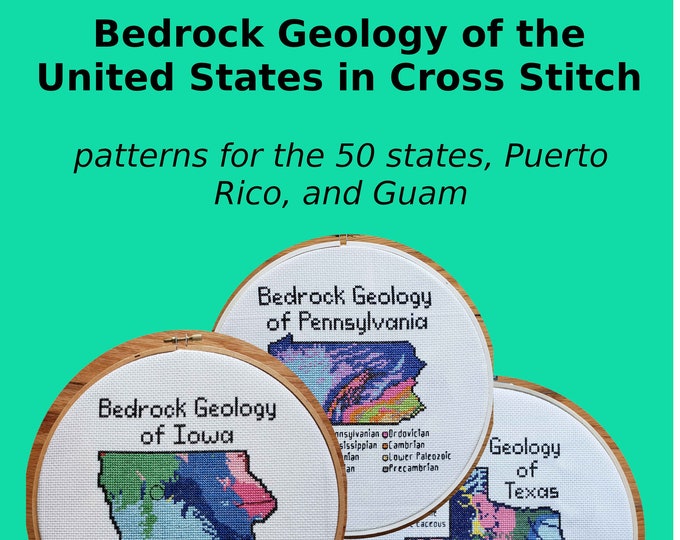
 One of the talks I enjoyed at this month's North American Cartographic Information Society Conference was from Kara Prior, who uses maps to create cross stitch pattern designs - on sale on her Etsy shop.

She details the process in her talk - now available on YouTube. The idea is to take a map and make it as low resolution as possible while still conveying information. That way you see the individual squares. Here is a screen shot from the video illustrating this.

One of my favorites is the bedrock geology of Arizona. The colors really jump out - some of them look like they were taken from the state's flag.

 
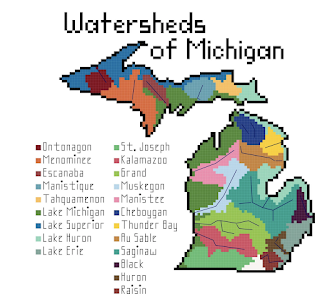
She also has bathymetry and watersheds as well as several other, non-map patterns. The watersheds can be quite simple such as New Jersey,

or much more complicated.

I'll end with some bathymetry examples


Wednesday, October 20, 2021

Chosin Reservoir Medal of Honor Map

Last week I attended the North American Cartographic Information Society Conference in Oklahoma City-virtually. There are always many inspiring maps to see there and I will likely be highlighting a few over the next few months. Here is a map by cartographer Gene Thorp showing the recipients of the Medal of Honor at the Battle of Chosin Reservoir in the Korean War.


The gold stars are the best available locations of the actions that thirteen service members were awarded for. The battle was a turning point in the early part of the Korean War when the Chinese entered the war and drove UN forces out of North Korea through treacherous frozen mountainous terrain. Thorp used terrain from Google Earth and shows a winter-time scene that does a good job of conveying the conditions. The map was exported to Adobe Photoshop and Illustrator where the annotation was created. 

This map is used by the National Medal of Honor Museum to visualize the extreme conditions these award recipients went through.


Wednesday, October 13, 2021

The Federal Republic of Central America

In September, 1821 Central America became independent from Spain. The newly formed nation, ruled from Guatemala, dissolved quickly as the countries were not able to unify and were absorbed by Mexico. After Mexico has its own political problems, the Republic of Central America was formed in 1823.

It only lasted until 1840 after Nicaragua, Honduras and Costa Rica separated and formed their own countries. Note that a large chunk of Nicaragua was part of Honduras at the time of this map. This area, the Mosquito (or Miskitu) Coast was part of a British protectorate, then was variously part of the two nations and now split between them. Here is a map of the area as an autonomous region.

Wednesday, September 29, 2021

The State Hate Map

I try not to post too many of these maps as they are often gratuitously nasty and extremely unscientific. However, in the spirit of fun here is every state's least favorite state by Matt Shirley.

While your Instagram following is clearly not a statistically approved sample, it does seem to accurately reflect my experiences in many of these states. I very familiar with the anti-Massachusetts thing in New England and the PA-NY hatred of New Jersey. I also have some personal experience with the Missouri-Kansas and Ohio-Michigan animosities. I've even experienced South Carolinians hating on Ohio. 

As a "helpful" device, Reddit user u/ayitasaurus made an arrow version. It gets a little hard to read on the east coast (a different color arrow would help) but you can certainly see all the silly state rivalries. Some interesting trends include the linear hate chain from Minnesota to Tennessee and Florida hating itself.


-via Digg